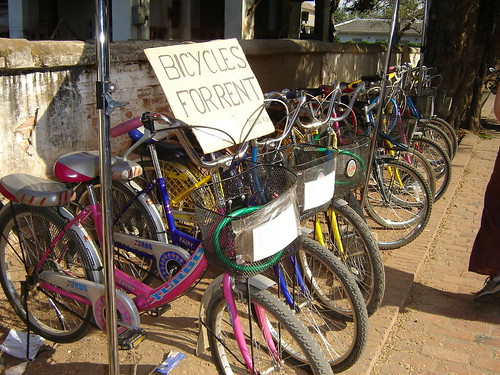
LUANG PRABANG, LAOS: Visitors to Luang Prabang will no longer be able to rent bicycles and motorbikes in the main town, following a ban by local authorities on these rental businesses.
The ban has been put in place despite complaints by some local residents that it will present a negative image of the town to tourists.
The Head of the Luang Prabang Tourism Office, Khamphui Phommavong, said Monday (21 Jan) that motorbikes and bicycles were a major cause of road accidents, as visitors often were not experienced at riding or did not understand the local road rules and caused confusion among other road users...more info
He added that the problems also included an increase in thefts of rental bikes from tourists, further tarnishing the image of the World Heritage-listed town.
“We want to encourage people to walk around the city,” he said. “Those who don't want to walk can always take tuk-tuks and vans to get around.”
However, local people will still be allowed to ride their motorbikes and bicycles, but should observe the traffic regulations.
A local tour guide, Champou, said the former owners of bikes for rent were now selling them to locals who wanted them for their children to ride to school.
Officials said tourists could still ride bicycles and motorbikes if they were part of a group tour with a guide as this would avoid problems.
Specific parking spaces would be arranged for tuk-tuks and vans, which would leave more walking space and cut down on traffic congestion.
Luang Prabang authorities are also discussing how to ease traffic flow by installing more signs and increasing awareness amongst local people of the regulations.
“Only after we have our traffic problems sorted out can we consider allowing rentals again. We expect this to be some time in 2010,” said Khamphui.
A senior official from the Lao National Tourism Administration, Saly Phimphinith, stated that the administration was aware of the issues and believed that improving the regulations would create a more ordered city and attract more tourists.
But critics say bicycles, at least, should be allowed in central Luang Prabang, as they do not cause pollution and the city is small enough to be suitable for bike riding.
In addition, they say more traffic police could be deployed to tell people when they are riding in the wrong direction or breaking any other rules.
Two years ago, Luang Prabang's governor issued an order banning bicycle and motorbike rentals in the town, but the order was not strictly enforced.
Authorities also banned buses in the central town area two years ago to help improve the traffic flow.
Luang Prabang became a UNESCO World Heritage town in 1995, on the condition that it attempts to preserve its urban environment.
However, the town centre has changed as hotels, restaurants and other businesses have been established to cater to the tourist trade, with visitors numbering more than 300,000 in 2007. Authorities are anticipating a further increase this year to 400,000. (By SOMSACK PONGKHAO/ The Vientiane Times/ ANN)
2:29 PM |
Posted in
agency,
bike,
Lao National Tourism Administration,
Laos 2009,
Luang Prabang,
motocycle,
rental,
Tourists
|
Read More »
 Laos to exempt VISA for Russian tourists
 (KPL) Laos is to discard visa requirements for Russians who go to the Southeast Asian country for under 15 days from September 19. With the decision, Laos becomes the second country in Southeast Asia after Thailand to exempt visas for Russian travellers, the Russian news net said.
According to statistics from the Russian Tourism Agency, the number of Russian tourists arriving in Thailand and Viet Nam in 2006 doubled compared to that of the previous year, while the figure to France dropped by 20 percent and the UK 16 percent. The reduction was attributed to complicated visa procedures in these countries, the news net stressed.
Source: kpl.net.la
2:45 PM |
Posted in
2007,
exempt,
Free,
Laos,
mobile vientiane,
Russia,
Russian,
Tourists,
visa
|
Read More »

Photo: Wat Xieng Thong is arguably the lovliest of the temples at Luang Prabang.
by: Kristi Ross, Contributor, Luang Prabang, Laos
If Luang Prabang (also known as Loungphrabang) didn't exist, only a poet or an opium dreamer would dare invent it.
The Mekong and Nam Khan rivers wrap around the ancient Lao capital like a shawl. Steps lead up from riverside jetties to streets shaded by trees whose skirts of roots are as wide as their crowns.
Along the main roads orchids and bougainvillea spill down from French colonial balconies and ground-floor cafes serve espresso, herb teas and flaky croissants...more
The back lanes are lined with traditional timber houses, textile galleries and mulberry-paper shops, punctuated by the flaring roofs of the wat (temples).
In the morning market, hill-tribe villagers offer pungent roots, forest greens and fresh-trapped game while town-dwellers crowd the benches of the noodle stalls.
Luang Prabang strides worlds, is ancient and contemporary, Lao and French, Mien and Hmong all at once.
*****
Once, it took longer to travel here up the Mekong than to sail all the way from France to Saigon. Now, flights arrive daily from Vientiane, Bangkok and Chiang Mai, but flying in dilutes the essence.
Better to take the highway from Vientiane, Laos' present-day capital, and wind up through improbable mountain ranges and great tracts of fresh-burnt swidden, deep primeval forests and stands of whispering teak.
Now and then the narrow, potholed road coils through linear villages of timber and bamboo where dark-bristled pigs with low-slung bellies doze in the shade and children set off from one or two-roomed schools, walking back to widely-scattered hamlets that can only be reached on foot.
Often, both highway and villages perch on the edge of nothing, looking as if they are about to tumble gracefully into valleys far below.
Travel through landscapes like these for 12 to 14 hours, and when the first unlikely rooftops appear in the last of the afternoon light, Luang Prabang appears not just as a cosmopolitan fusion, but as a deeper mystery.
Dawn brings brief reverberations from monastery drums, pearly light shimmering on tile roofs, roosters crowing out their territories in villages across the rivers still hidden by morning mist.
All along the narrow peninsula of the old town, men and women slip quietly out of doorways to wait along the pavements as they have done for centuries. Soon the monks will come, long shuffling snakes of saffron, burnt orange and gold, and the laity will lay up merit in this life or the ones to come by spooning handfuls of sticky rice into begging bowls.
At Wat Xieng Thong, loveliest of all the town's temples, the bamboo shingle roofs sweep down almost to the ground, sheltering walls patterned with a mosaic of blue, green and turquoise glass.
While the monks are out on their morning rounds, the courtyard is deserted save for hopping sparrows and dozing cats. A sunbeam splashes through the open door of the sim, lighting the huge Buddha image at one end and all the smaller ones in gold and bronze that rise in a pyramid around him.
A faint breeze stirs the golden leaves of a bodhi tree ornament on the altar. Somewhere, a drum sounds. In the silence that follows, peace oozes out of the ancient walls.
Source: The Jakarta post
4:54 PM |
Posted in
information,
Laos,
Luang Prabang,
Tourists,
world heritate
|
Read More »

By: Diana Plater
The Australian, Irish and Welsh backpackers I met at the Hive bar in Luang Prabang, Laos, invited me 10 pin bowling.
It's not the sort of thing you'd expect to do in a UNESCO-protected town high up in the mountains of northern Laos.
But not surprisingly this town has few western night clubs or late night bars.
And the only place to drink late at night in town is at the bowling alley...more
But, by the time we'd had a few drinks of beer Lao, a deliciously spicy dinner at one of the many restaurants in town, then nightcaps of Lao Lao (or locally-made whiskey) with local Diet Coke (I'm not sure what was worse) we never got there.
I was lucky to find a tuk tuk driver to take me back to my hotel.
It was a fairly active night for what could be one of the most languid places I've ever been to.
It's almost as if time stands still in this French colonial town known more for its spirituality than bowling.
Even the Buddhist monks seem to move slower than normal.
And walking around town in 38 degree heat, I'm reminded that only mad dogs, Englishmen and then maybe tourists go out in the midday sun. It's so hot you can almost feel the air swallowing you. Everybody else seems to be lying inside or in the shade using as little energy as possible.
It's low season and local school holidays. They say Christmas time is better for visiting and can even get chilly at night.
I visit the 16th century Wat Xieng Thong, known as a masterpiece of Buddhist architecture with a tiered roof, glittering golden facades and richly coloured mural painting. It's a working temple and monks have hung their orange robes out to dry after doing their laundry.
I stop for an iced lemon tea and lunch at one of the riverside cafes overlooking the murky brown waters of the Mekong. The son of the restaurant owner is painting pictures of monks with pen and ink on saa paper made from the mulberry tree and its bark.
He tells me he's an art student. The town seems to be full of them, if you go by the number of art shops and galleries.
In the late afternoon, men play boule along the river front, on even the smallest patch of dirt.
In his book The Mekong: Turbulent Past, Uncertain Future (Allen and Unwin, 2006), former Australian diplomat Milton Osborne says the Mekong has ``always been a river for work, for travel and for fishing, and, not infrequently, for war''.
Luang Prabang was once known as Asia's sleeping beauty. The former capital of the ancient Lam Xang kingdom, with around 32 pagodas along with religious and historical monuments, was made a World Heritage town by UNESCO in 1995.
It has especially strong ties with Buddhism, being a traditional destination for novices and students of the faith.
Flying over the mountains on the way in, you can't imagine anybody living in such rugged land. This is the country where what became known as The Secret War was played out - US bombings including attacks on what came to be known as the Ho Chi Minh Trail, a North Vietnamese supply route through East Laos and the Cambodian-Vietnam border.
The Communist Pathet Lao took over in 1975; they've only opened the place to tourism in the past 10 years. Now, around 140,000 people or seven times the city's estimated population visit the place over a one-year period.
UNESCO's role is partly to try to support the town's growth within the framework of strict controls so the historic buildings are preserved.
Development must take into account ancient Laotian social, architectural and religious mores.
Buddhism is a force that underpins every aspect of life here.
Around 6am every day, hundreds of monks and novices attend the alms-giving ceremony, where locals give them sticky rice, fruit and sweets.
Tourists are asked not to be obtrusive.
The Pathet Lao forced the last king of Laos, Savang Vathana, to abdicate, snuffing out a 600-year-old monarchy. Twenty years later, Christopher Kremmer, an Australian foreign correspondent, tried unsuccessfully to crack the mystery behind the fate of the royals - as outlined in his book, Stalking the Elephant Kings: In Search of Laos.
The former Royal Palace is now a National Museum, which is worth visiting for its rooms that give a glimpse of what life was once like for the royals. There's an eclectic mix of exhibits, including gifts from other countries, among them a boomerang from Australia.
It's where the Pha Bang Buddha is kept, which gives the town its name.
It's said to be have been cast in Sri Lanka in the first century AD and twice stolen by the Thais. But, it has been back in Laos since the mid 19th century.
A beautiful exhibition known as The Quiet in the Land of Buddhism-inspired images, including photographs, was on display in an outer building.
Luang Prabang is now on the backpacker route. My new friends had made their way across country after doing an elephant trek near Chiang Mai in northern Thailand then crossed the border and came by boat up the river, taking two days to get there. Others come down the river from Vietnam.
And it's also a town with a growing number of more well-heeled visitors.
Many fly in to what is considered one of the most difficult airports to land in in South-East Asia.
The hotel where I'm staying, La Residence Phuo Voa, has a spa which overlooks the mountains with its own small swimming pool - lazing in it after a massage is like having a huge bath to yourself.
At night, staff place candles in the main swimming pool overlooked by the floodlit shrine on top of Mount Phou Si. The food at its Phou Vao restaurant is traditional Laotian cuisine alongside European dishes with local influences.
The walk up Mount Phou Si from the town gives spectacular views and is popular at sunrise and sunset.
Apart from exploring the town and its wonderfully photogenic architecture and temples, shops and galleries there's also the night markets full of traditional clothes, woven cloth, scarfs, jewellery and souvenirs.
The only two relatively close excursions out of town are the Pak Ou caves and the Kuang si waterfall. Many agencies run half-day tours. But then there's also bowling.
IF YOU GO:
La Residence Phou Vao is from $141 per room per night for a garden view room.
To book/query call Orient-Express Hotels (02) 8248-5200 or email: charlie.turnbullorient-express.com
Also visit www.residencephouvao.com.
Bangkok Airways flies daily and sometimes twice daily between Bangkok and Luang Prabang. Details: visit www.bangkokair.com
Qantas flies to Bangkok. Visit www.qantas.com.
Source: www.brisbanetimes.com.au
10:36 PM |
Posted in
2007,
Australia,
bowling,
Lao National Tourism Administration,
Laos 2009,
LP,
Luang Prabang,
paras,
Savannakhet travel,
Tourists,
valley
|
Read More »

Will Hide finds peace and quiet – and his dancing feet – in Luang Prabang, the Asia travellers’ new darling
The children at Viengxay primary school in northeast Laos, not far from the border with Vietnam, seemed rather calm considering a sweaty Englishman carrying a backpack had just tripped over the wall into their playground. The group of 30 or so cast a glance in my direction as I dusted myself down, then quickly went back to the more important matter at hand, their game of boules...
more A flick of the wrist, a ball flying through the air, a collective holding of breath, a thud followed by a clack and a muted cheer. A tall boy, the victor, beamed and patted his opponent on the back and was just about to suggest another game when the bell – actually the empty shell of an American bomb – was thwacked by a teacher and in moments the playground was empty. I excused myself and started back on my trail, looking hopefully for a path to the river and a boat that would take me back towards Luang Prabang.
Aside from boules and baguettes and a few whitewashed villas you wouldn’t guess the French had ruled Laos half a century ago. And apart from the odd shell casing made into a school bell or plant pot, a tourist wouldn’t guess that, between 1964 and 1973, the US dropped almost two million tonnes of explosives on Laos, making it, per inhabitant, the most bombed nation on earth. That the people of this small, landlocked country seem more wary of outsiders and more hesitant with a smile than their Thai neighbours is, perhaps, understandable.
Like Kathmandu and Koh Samui before it, Luang Prabang is the Asia travellers’ new darling. The ancient town – you’d be pushing your luck to call it a city – lies at a confluence of the Mekong and Nam Khan rivers and has been a Unesco World Heritage Site since 1995. Those pressed for time can fly in from Bangkok, although a more leisurely way is the two-day boat trip down the Mekong from the Thai border at Huay Xai, or by bus from the capital, Vientiane, breaking the journey at Vang Vieng to float lazily downriver on inner tubes.
Alongside Luang Prabang’s shuttered old French colonial buildings are almost 70 Buddhist wats (temples), half of which are still occupied by saffron-robed monks. There are also dozens of small cafés serving everything from traditional laap (a salad of minced meat, lime juice, garlic, mint and chillies) with a bottle of cool Beerlao, to cappuccinos, chocolate brownies and, the backpackers’ favourite, banana pancakes.
Italian tour groups and Israeli backpackers potter around on bicycles hired for a couple of dollars a day, take longboats up the river to visit the Pak Ou caves crammed with hundreds of statues of Buddha, walk up Mount Phu Si, join the monks in the internet cafés on Sisavangvong Street (a rather surreal sight at first), take a £3-an-hour massage and browse for T-shirts and lanterns at the night market. Accommodation ranges from dollar-a-night crashpads to restored mansions such as the Apsara, a dream of a place with an open front facing the river, creaking wooden floorboards, whirling fans, black and white photos on the wall, glass Buddhas in alcoves and the best bar and restaurant in town.
I wondered aloud, though, to the hotel’s English owner, Ivan Scholte, what Luang Prabang might be like in ten years’ time, a victim perhaps of its own success? Already the ancient daily early morning ritual of tak bat – giving alms to the town’s monks – has become something of a bun flight in places, with tourists jostling for the best photo spots.
“Some feel Luang Prabang should attract a much larger number of tourists and incorporate the infrastructure to accommodate them, including golf courses and bigger hotels,” he says. “This will probably bring in more money initially but the essence of the town will change dramatically as it becomes a theme park. Others feel the authorities should try to bring in a more discerning type of visitor who in the long term will have less of an influence on the local way of life.
“On a more optimistic note, it’s largely due to the Unesco World Heritage status that Luang Prabang has remained as lovely as it is. I think the town looks better today than when I arrived five years ago.”
Certainly sitting in the peaceful Tamarind Café, slurping a strong Lao coffee topped up with condensed milk, and scooping up spicy dips with crisps made from river weed and sesame seeds while listening to the monks chanting in Wat Nong across the road, I couldn’t help but hope that any future growth is managed well.
The next morning I was driven three hours north to the village of Ban LaKhon, by fields of buffalo and rice, overtaking families on mopeds, then alongside mountains hugged by mist, thick with teak and bamboo, past villages where satellite dishes cast shadows on baskets of bright red chillies. There I met my guides, Muen and Champoo, and we walked all afternoon through paddy fields and woods to the dirt-poor village of Phayong, miles from the nearest road, where a very basic B&B has been set up to give tourists an insight into the lives of the Hmong and Kamu people who live there. In the evening I sat down with the head of the village, Mr Vang, and dined on rice, fried greens, salty soup and scrawny chicken, illuminated by a candle balanced on an empty tin of rat poison, before turning in for an early night. Lao cockerels are no respecters of dawn, however, deciding to announce the new day at 3.30am. By the time I slothfully dragged myself out of bed at first light just after six, I seemed to be the last person in the village up and about.
Returning by riverboat to Luang Prabang I spent my last night in Laos at another, more upmarket eco-resort, Kamu Lodge, a great example of putting money directly into locals’ pockets without resorting to scratchy loo paper, nettle soup or hair shirts. The semi-permanent tents, well disguised by thick foliage, were more like something from an African safari. The interaction with the village next door seemed not too intrusive, the food delicious and even the evening entertainment of bamboo-pole dancing – skipping between them as they are banged together at ankle level, participation mandatory – managed, just about, not to be too cringe-making. Maybe it was the free-flowing Beerlao, maybe I was too chilled to care that I looked like a berk. Laos, Luang Prabang in particular, certainly does seem to have a rather calming effect.
Need to know Will Hide travelled with Selective Asia (0845 3703344, www.selectiveasia.com), which offers ten-day trips, including accommodation, guiding and some meals, but not flights, from £395pp. He booked flights through Travelmood (0871 2266111, www.travelmood.com), which has return flights to Luang Prabang, via Bangkok, from Heathrow from £789.
Reading: Laos (Lonely Planet, £12.99), Ancient Luang Prabang by Denise Heywood (River Books, £16.95), Ant Egg Soup – The Adventures of a Food Tourist in Laos by Natacha du Pont de Bie Sceptre, £7.99)
Red tape: A 15-day visa costs $35 cash on arrival with one passport photo. Air departure tax is $10 cash.
Source: travel.timesonline.co.uk
10:29 AM |
Posted in
beautiful,
capital,
charm,
entry,
Laos,
love,
Luang Prabang,
mobile vientiane,
Monk,
Old,
passport,
scene,
Tourists,
traveller,
travellling,
visa
|
Read More »

In Luang Prabang's main street, Xiang Thong, this deeply spiritual ritual has veered into a tourist circus, with visitors from all over the world barring the way to the procession. The tourists outnumber the faithful. To view photos in series,
click here:.
Source: travel.guardian.co.uk
7:12 AM |
Posted in
alm,
camera,
Laos,
living,
Luang Prabang,
Monk,
morning,
photographers,
photos,
street,
threatening,
Tourists,
traditional,
visitors,
way,
world,
World Heritage
|
Read More »

Vientiane sees higher tourist arrivals
(KPL) This year, Vientiane Capital expects to welcome more than 700,000 tourists, said Deputy-Head of Vientiane Tourism Administration Office, Mr. Khamkhoun Bailatri.
Nowadays, accommodations and other tourist facilities in Vientiane Capital are being developed and improved, such as tourism information, hotels, guesthouses, restaurants, road communications and tourism sites. Mr. Khamkhoun continued that the Vientiane Capital tourist office expected that almost 800,000 tourists would visit the Capital, a rise of 4 per cent over the previous year. This will generate over USD70 million for the capital.
In 2007 there will be 249 accommodations compared to last year increased to seven places, 67 restaurants increased to three places and four cruise ships.
Next year, the Vientiane Tourism Administration forecasts more than 800,000 tourists will visit Vientiane Capital and money will flow USD75 million and Vientiane Tourism Administrative will prompt local businessmen to invest in the construction of accommodations to cope with the increase of tourists seems a risen every year.
On the occasion of Lao New Year celebration falling on 13 to 16 April, the National Tourism Administration will organise an international skydiving at Don Chan beach, it expects to draw about 80 -100 foreign parachutists and 20 Lao volunteer parachutists.
1:15 PM |
Posted in
capital,
heritage,
hotels,
Laos 2009,
new year 2007,
sites,
Tourists,
vientiane tourism,
visa
|
Read More »

LUANG PRABANG, Laos : World heritage status has turned the former Lao capital from a ghost town into a tourism hub, but too much of a good thing could soon prove the kiss of death, say experts and residents.
In recent years a trickle of backpackers has turned into a flood of tourists coming to the sleepy town of glistening Buddhist temples and palm shaded French colonial mansions sitting pretty on a Mekong river peninsula.
Camera-toting visitors now follow saffron-robed monks on their morning alms rounds and foreigners are transforming quiet neighbourhoods into rows of cafes and hotels, say those who worry about the town's fragile beauty.
"People are surprised at the pace of change," said Francis Engelmann, a former UNESCO advisor and current resident of Luang Prabang. "There are more cars, there is more noise. Behind my house three new guesthouses are going up." ... more info
The 700-year-old town, seen as the jewel of ancient Lao heritage, threatens to turn into "a mono-industry where everything depends on tourism," he warned.
By the standards of many Asian tourist sites, Luang Prabang retains much of the tranquil charm that led the UN Educational, Scientific and Cultural Organisation to list it as a world heritage site in 1995.
Nestled below lush hills between the Mekong and Khan rivers, it was once the capital of the Lan Xang kingdom, the Land of One Million Elephants, and remained the spiritual and religious centre of Laos in the centuries since.
The town's fortunes took a dive during the Vietnam War, when US forces fought communist troops in Laos, and in the post-war years from 1975 when the new socialist regime shuttered most of the country's Buddhist temples.
From the late 1980s a few hundred intrepid travellers per year returned to Luang Prabang as Laos re-opened to the outside world, but the years of neglect had taken a heavy toll on Luang Prabang's former royal beauty.
"When I first came here in 1988-89, it was a ghost town," said Engelmann.
"There were only old people and it was a sad place, like a town after an epidemic. Everything was closed and roofs were caving in. The young people were all in Vientiane. Now they have all come back."
World heritage status has placed Luang Prabang firmly on Indochina's tourism map alongside UNESCO-listed sites such as the Angkor Wat temples of Cambodia and the karst islands of Halong Bay in Vietnam.
The UN body imposed strict preservation guidelines, which banned demolitions within the heritage zone and mandated the use of local materials for repairs, overseen by the local Heritage House foundation.
In 2000 UNESCO launched the Monk Project, in which elder craftsmen passed on skills such as wood-carving, mural painting and lacquerwork to young Buddhist monks to maintain the authenticity of temples here and across Laos.
By 2003, the tourism boom was bringing 600,000 visitors a year, says UNESCO, as guesthouses, riverside restaurants and handicraft shops mushroomed, increasing the strain on the town's electricity, water, sewage and garbage services.
The UN cultural agency warned in a 2004 report that development pressure had placed "critical stress on both the environment and the historic cultural resources of Luang Prabang and threatens to overwhelm them".
It warned of a future where "billboards dominate the landscape, where the sound of tour buses drowns out the soft temple prayers, and where the town's residents are reduced to the roles of bit-players in a cultural theme park".
"Today business is good," said Gilles Vautrin, a seven-year resident and owner of several restaurants here. "But the quality of life is not so nice anymore. It's faster and faster and there is more noise."
Vautrin said tourists wearing shorts now crowd out many of the 34 temples that are the core of the town's spiritual heritage and which have always been financed by the Lao residents, some of whom are now leaving town.
"It's become a falang city," he said, using the Lao word for foreigner.
"Many falangs rent houses for 30 years, but who's going to give food to the monks now? The alms-giving round is more like a show, like theatre. The Lao people don't say anything, but I think they don't like it."
He added: "Now the problem is the mass tourism. We're worried about the impact of large Chinese tour groups coming down the Mekong River.
"I think one day the monks will disappear to another retreat, and then we'll lose a lot. The spirit of the town will disappear."
Engelmann agreed that tourism has been a double-edged sword here.
"If you ask businessmen, they'll say it's fuelling business," he said.
"If you ask environmentalists, they'll say it's destructive. If you ask locals, they may say it's bringing jobs, but also driving up prices."
UNESCO listing, he said, "has been good for the 'hardware' - the architecture - but not the 'software' - the people, the monks, the rituals." - AFP/ch
Source: www.channelnewsasia.com
12:36 PM |
Posted in
Backpackers,
Buddhism,
Capaital,
elephents,
heritage,
lao new year,
Laotian,
Luang Praabang,
Mekong,
Old,
pub,
rivers,
song khran,
Tourists,
UNESCO,
University,
Vientiane,
water festival
|
Read More »

